
Superintendent of the Year and 2025 Rounds 4 Research


Also I want to start asking for donations to Rounds 4 Research for 2025, we did very well this year and hope to do better next year. Remember if you donate golf rounds you and your staff get your dues waived for the year. The money we make from this program helps us run the chapter and allows us to keep our dues and tournament entry fee’s down.
to complete the form.
Russell Dooge, CGCS
Executive Director HGCSA
Aerification, it’s that time of the year again!
“HGCSA Corner”
from the HSGA Newsletter – September 2024 – Issue 134
By Nolan Johnson
Director of Operations & Agronomy Makalei GC
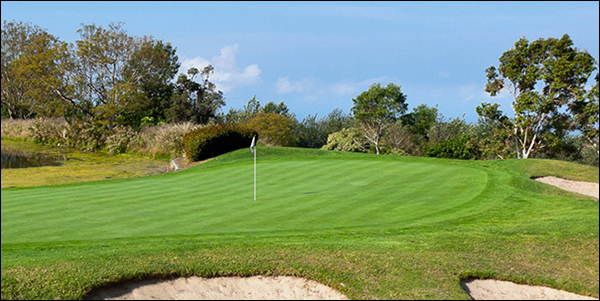
Aerification, it’s that time of the year again! As Superintendent’s, we see the look of frustration on your faces as you unknowingly show up to a course that were recently punched. Let’s face it, no golfers are ever thrilled to arrive at a course, only to find that they will be putting on greens that have just been aerated. There is a misconception that golf course Superintendents love aeration and we do it to make golfers mad. Nothing can be further from the truth.
From the Maintenance side: it costs a large amount of money to complete, it is time consuming, it wreaks havoc on equipment/mower reels/bedknives, and staff morale usually declines for the backbreaking work.
From the Operations side: there is usually a loss in revenue, staff has to deal with frustrated guests, the greens are slower and difficult to read, the roll is almost always affected, and sand gets everywhere.
So why do it? Because it’s the single-most important practice done on the course:
- Relieves Soil Compaction: Over time, the constant foot traffic and weight of maintenance equipment can compact the soil, reducing its ability to absorb water and nutrients. Aerification alleviates this compaction, allowing roots to grow deeper and stronger.
- Enhances Water and Nutrient Uptake: The holes created during aerification allow water, fertilizers, and air to reach the root zone more effectively. This improved access supports the turf’s health, making it more resilient against drought and disease.
- Reduces Thatch Buildup: Thatch, a layer of dead grass and organic matter, can accumulate on the surface and hinder water infiltration. Aerification helps break up thatch, preventing it from becoming too thick and suffocating the grass.
- Promotes Healthy Root Growth: By creating spaces in the soil, aerification encourages roots to expand and grow deeper. This leads to a more robust root system that can better withstand environmental stresses.
For more information on golf course maintenance practices to promote healthy turfgrass management, feel free to visit the USGA website, Course Care page.
2024 University of Hawaii Zoominar Series
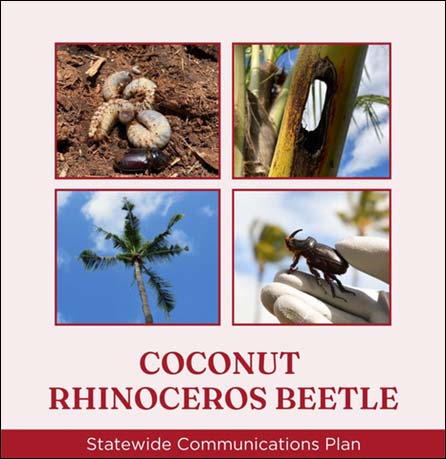
Hawai’i Coconut Rhinoceros Beetle Communications Plan
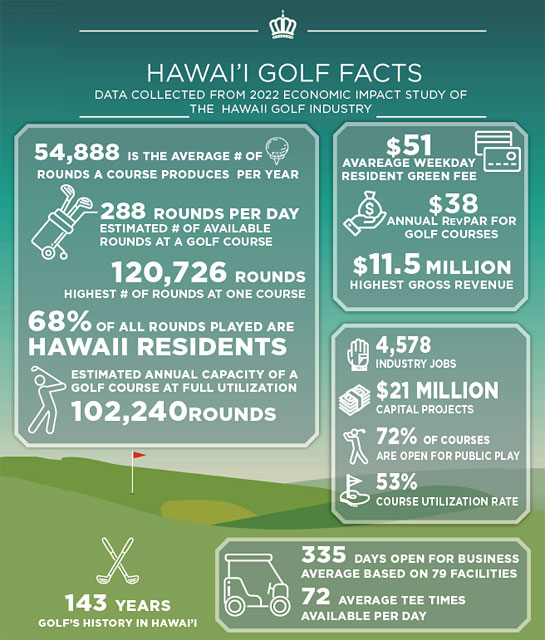
The Hawai’i Golf Economy – An Economic Impact Analysis
Discover the economic heartbeat of Hawaii’s golf industry!
We are thrilled to announce the publication of the "Hawai’I Golf Economy 2023 Economic Impact Analysis." This comprehensive report, released by The PGA of America – Aloha Section and Foundation, sheds light on the significant economic contributions of golf to our home islands.
Golf isn't just a sport; it's an integral part of Hawaii's economy, supporting jobs, generating revenue, and driving tourism. Through this analysis, we gain valuable insights into the economic footprint of golf in our state, reaffirming its status as a vital industry.
As stewards of Hawaii's golf courses, it's crucial for us to understand and appreciate the economic impact of our sport. By sharing this report on our website, we aim to inform, educate, and advocate for the continued growth and prosperity of the golf industry in Hawaii.
We encourage all members, stakeholders, and golf enthusiasts to explore the findings of the "Hawai’I Golf Economy 2023 Economic Impact Analysis" and join us in celebrating the economic power of golf in Hawaii.
Together, let's continue to champion Hawaiian Golf and its positive contributions to our communities and economy.
Key highlights from the Economic Impact Analysis include:
- Combined financial outlay of $393 Million annual from operational revenue and capital investments.
- Over $1 Billion dollars generated in annual golf tourism and golf-related retail spending.
- Homes values adjacent to golf courses increase property values by an estimated 32% resulting in real property tax collections in golf course communities amounting $2,695,761.
- Direct economic impact of $1.8 Billion and $1.6 Billion from indirect economic impact from core industries bringing the total economic contribution to the Hawai’i economy of $3.4 Billion dollars.